


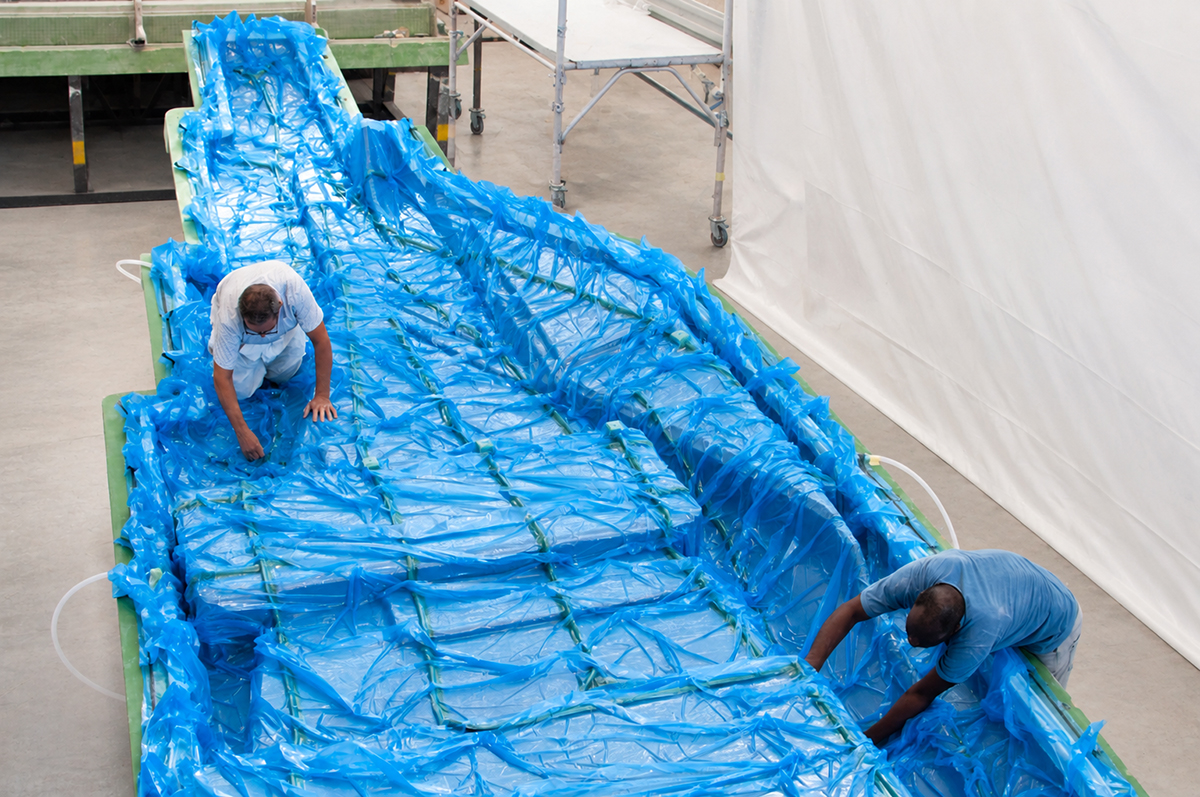
At Gregorini, we specialize in vacuum infusion boats Advanced for international clients seeking superior structural integrity without weight penalties. This technical guide explains why international shipyards are increasingly outsourcing their infusion projects to our specialized facilities.
What is Vacuum Infusion Boat Building?
Vacuum infusion (also known as resin infusion or VARTM – Vacuum Assisted Resin Transfer Molding) is a closed-mold composite manufacturing process in which dry fiber reinforcements are placed in a mold, vacuum-sealed, and impregnated with resin through controlled pressure differentials.
Unlike traditional hand-lamination methods, the vacuum infusion boat service offers:
- Precise resin-to-fiber ratio control (typically 30-40% resin content vs. 50-60% in hand lay-up)
- Superior mechanical properties with consistent laminate quality
- Reduced weight without compromising structural strength
- Lower VOC emissions and improved workplace safety
- Minimal material waste and optimized production costs

For international shipyards seeking a reliable partner for vacuum infusion services, Gregorini offers the technical expertise, production capacity, and quality standards required for a competitive advantage in the global marine market.

Technical Advantages for International Shipyards
1. Enhanced Strength-to-Weight Ratio
Vacuum infusion produces laminates with up to 20% weight reduction compared to conventional methods while maintaining or improving mechanical properties. For performance vessels, racing yachts, and commercial craft, this translates directly into:
- Higher speeds with the same power output
- Improved fuel efficiency and range
- Greater payload capacity
- Enhanced handling and seakeeping
2. Superior Structural Integrity
The controlled environment of vacuum infusion boatbuilding eliminates voids, air pockets, and dry spots common in open-mold processes. The result is:
- Consistent fiber wet-out throughout the laminate
- Higher interlaminar shear strength
- Improved fatigue resistance for long-term durability
- Better dimensional stability and reduced warpage
3. Cost Efficiency at Scale
While initial setup requires specialized equipment, vacuum infusion boat building service delivers significant ROI for production runs:
- Reduced material consumption (less resin waste)
- Lower labor costs per unit
- Faster cycle times for repetitive parts
- Predictable quality reducing rework and warranty claims
Why Foreign Shipyards Choose Gregorini for Infusion Projects
State-of-the-Art Infusion Facilities
Our dedicated vacuum infusion boat building service centers feature:
- Climate-controlled production bays (temperature and humidity management)
- Advanced vacuum pump systems with real-time monitoring
- Resin delivery systems with precise metering and mixing
- Clean room environments for critical structural components
- Capacity for hulls up to [insert maximum length] meters
Technical Expertise for Complex Projects
Our engineering team specializes in:
- Multi-axis infusion modeling to predict resin flow patterns
- Custom mold design optimized for infusion processes
- Material selection matching performance requirements and certification standards
- Process validation and documentation for class approval
Quality Assurance & Certification Support
Every vacuum infusion boatbuilding project includes:
- In-process monitoring with vacuum gauges and flow sensors
- Post-cure inspection using ultrasonic testing and thermography
- Full material traceability from raw components to finished part
- Documentation packages for RINA, Lloyd’s Register, DNV, and CE certification
The Gregorini Process: From Design to Delivery
- Technical Consultation: Review of specifications, performance requirements, and certification needs
- Feasibility Analysis: Assessment of mold compatibility, material selection, and infusion strategy
- Process Engineering: Development of infusion maps, gate/vent placement, and cycle time optimization
- Process Engineering: Development of infusion maps, gate/vent placement, and cycle time optimization
- Quality Control: Inspection, testing, and documentation
-
Delivery: Secure packaging and logistics coordination to your shipyard
