


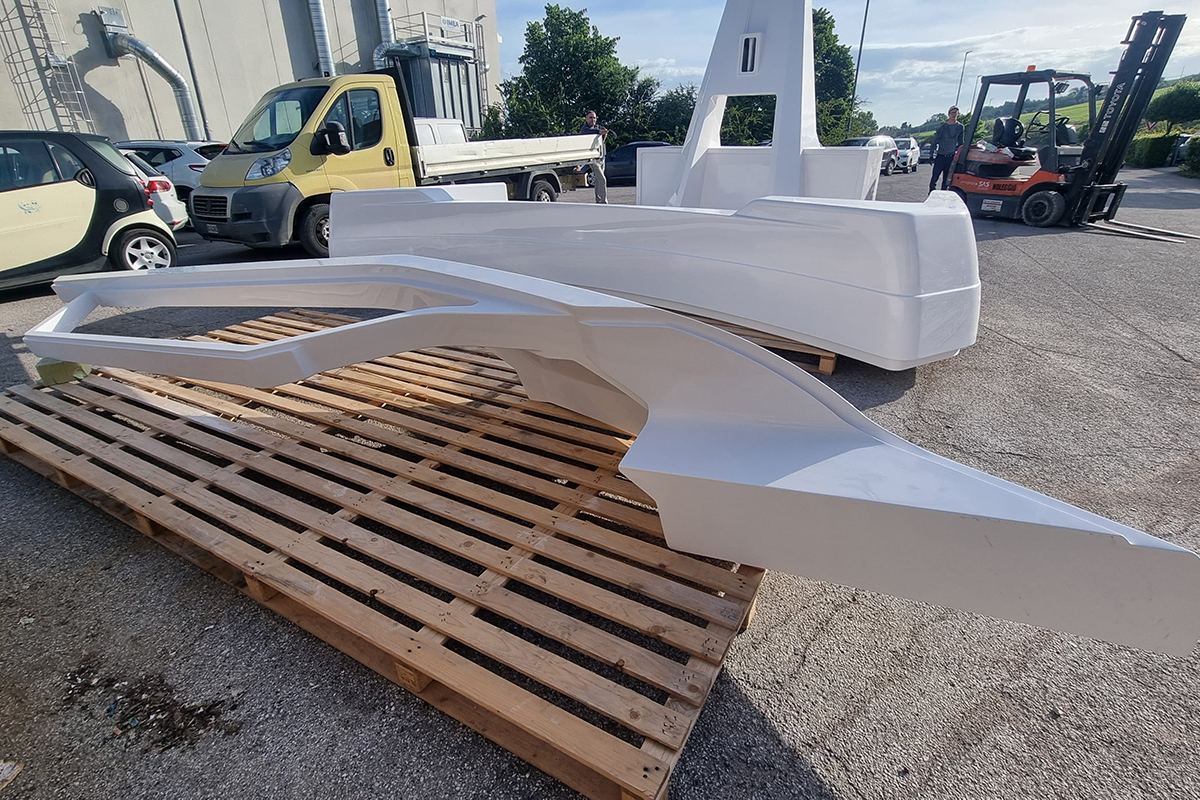
Phase 1: Engineering and Mold Design
The meeting point between the designer and production.
Everything begins with the analysis of the 3D file provided by the naval architect. Our technical office works closely with designers to optimize the model for manufacturing:
- Shrinkage Compensation: Calculation and application of anticipated deformations to compensate for the natural shrinkage of fiberglass during the curing process.
- Draft Angle Analysis: Verification of draft angles to ensure perfect and damage-free extraction.
- Parting Line Planning: Definition of parting lines to minimize aesthetic and structural impact on the final hull.

Millimetric precision at the service of the marine industry.
CANTIERE NAVALE GREGORINI

Phase 2: Master Model (Plug) and Mold Construction
- Plug Milling: Creation of the master model (plug) in high-density resin or technical wood using 5-axis CNC milling machines, ensuring absolute fidelity to the original design.
- Preparation and Polishing: The plug is faired, sanded, and mirror-polished to achieve a flawless surface finish (Class A).
- Mold Lamination: A specific tooling gelcoat is applied to the plug, followed by a multi-layer structural lamination (often reinforced with steel or aluminum ribs) to guarantee rigidity and thermal stability.
- Extraction and Finishing: The mold is extracted, cleaned, and prepared with closure systems and injection/vent channels (if vacuum infusion is planned).
Phase 3: The Lamination Process
Where the design comes to life.
Once the mold is ready, fiberglass lamination contract manufacturing begins. Depending on the designer’s specifications, we choose the most suitable technology:
- Hand Lay-up: Ideal for complex components, local structural reinforcements, or low-volume production. Our expert laminators guarantee a perfect fiber-to-resin ratio and the absence of air bubbles. I nostri laminatori esperti garantiscono un perfetto rapporto fibra/resina e l'assenza di bolle d'aria.
- Vacuum Infusion: The preferred choice for large hulls and high-performance components. It allows for lighter, stronger laminates with an excellent fiber-to-resin ratio, while reducing emissions.
- Gelcoat Application: Spraying of the gelcoat with controlled thickness to ensure osmotic protection and aesthetic perfection of the outer layer.
Phase 4: Curing, Demolding, and Finishing
The transformation into a finished product.
- Curing: The part is left to cross-link. In some cases, we use controlled post-curing to maximize the mechanical properties of the composite materials.
- Demolding: The hull or component is extracted from the mold using techniques that preserve surface integrity.
- Trimming and Drilling: Trimming of excess edges and precision drilling for system pass-throughs, executed via CNC pantographs to guarantee repeatability.
- Assembly and Structural Bonding: Joining of the hull and deck, installation of bulkheads, reinforcements, and integration of secondary structural components.
The Added Value for Shipyards and Designers
- For Designers: Absolute respect for the original design. We provide feasibility reports and technical suggestions during the CAD phase to avoid costly redesigns later.
- For Shipyards: Production scalability. You can accept larger orders without overloading your own tooling departments, keeping your quality standards unchanged.
- Integrated Quality Control: 3D laser dimensional inspections to verify that the mold and the first produced parts meet the tolerances of the naval design.
Technical Partner for Your Next Production
Whether you are a shipyard needing to outsource a production run or a design studio looking for a partner to build the first prototype, Gregorini is your ally in fiberglass lamination contract manufacturing.
